

johndoe@gmail.com
 Facebook
Are you sure you want to reset the form?
Your mail has been sent successfully
Are you sure you want to remove the alert?
Your session is about to expire! You will be signed out in
Do you wish to stay signed in?
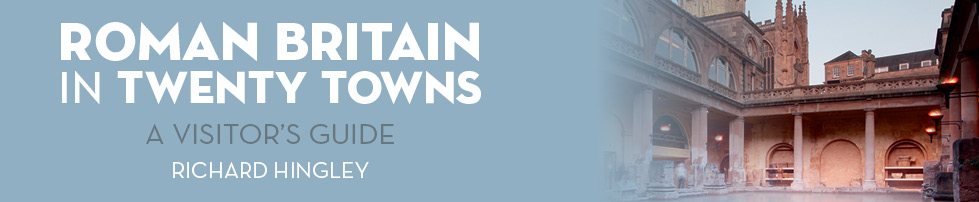
.
WEBSITES relevant to exploring each of the Roman towns included in the book
Aldborough
For the English Heritage website for Aldborough, see (https://www.english-heritage.org.uk/visit/places/aldborough-roman-site/). The Friend of Roman Aldborough also has a helpful website which includes information about the site and events at the site, at (https://romanaldborough.co.uk/). For a guide to exploring the local landscape, see (https://www.soundmarks.co.uk/map)
Bath
For the park and ride at Bath, see (https://travelwest.info/park-ride/). For the Roman Baths, see (https://www.romanbaths.co.uk/). This website includes a 3D viewer of what is visible at the Roman Baths and detailed information on the artefacts in the museum.
Caerwent
For the Cadw guide to Roman Caerwent, see (https://cadw.gov.wales/visit/places-to-visit/caer-went-roman-town). For the legionary fortress at Caerleon, see (https://cadw.gov.wales/visit/places-to-visit/caerleon-roman-fortress-and-baths). The finds from the early excavations at Caerwent are displayed in Newport Museum and Art Gallery (https://www.visitwales.com/attraction/museum/newport-museum-and-art-gallery-1104631).
Caistor St Edmunds
For information about the site provided by the Norfolk Archaeological Trust, see (https://www.norfarchtrust.org.uk/project/caistor-roman-town/).
Canterbury
The website for the Roman Museum, which includes an interactive video about the Roman house dislayed in the building, is at (https://canterburymuseums.co.uk/canterbury-roman-museum/). For Bigbury Camp, see (https://www.kentwildlifetrust.org.uk/nature-reserves/bigbury-camp). The Roman phases of the Whitefriars excavations have still to be published but some information is accessible at (https://www.kentarchaeology.org.uk/magazine/60/01-whitefriars-highlights).
Chichester
For the North Bersted Warrior, see (https://www.thenovium.org.uk/mysterywarrior). For additional information on the bathhouse at the Novium Museum see (https://www.thenovium.org.uk/article/27248/Bath-house). For the town walls, see (see https://www.chichesterwalls.org).
Cirencester
For the walking guide to the Iron Age oppidum at Bagendon, see (https://refitproject.files.wordpress.com/2017/03/bagendon-pdf-walking-guide-2017.pdf). For the National Trust website for Chedworth Roman Villa, see (https://www.nationaltrust.org.uk/visit/gloucestershire-cotswolds/chedworth-roman-villa). For the website for Corinium Museum, see (https://coriniummuseum.org/). For the Dyre Street mosaic, see (https://coriniummuseum.org/2020/09/discovering-the-seasons-mosaic/). For the palindrome from Victoria Road, see (https://raffaellabetti.wordpress.com/2010/08/03/the-square-of-sator-english/). Cotswold Archaeology publications on Cirencester are available at (https://cotswoldarchaeology.co.uk/publication_category/cirencester_series/).
Colchester
The website ‘Visit Colchester’ has informative guides to Roman sites in and around Colchester (https://www.visitcolchester.com/explore/colchesters-history/roman-colchester). These online materials provide accessible guides for visitors, links to the Castle Museum and the Circus Visitor Centre, and details of two walking tours for visiting the Roman sites and the town walls. For the Lexden Dykes, see (https://www.english-heritage.org.uk/visit/places/lexden-earthworks-and-bluebottle-grove/History/). For an online guide to the walls, see (https://assets.simpleviewinc.com/simpleview/image/upload/v1/clients/colchester/Walking_Walls_Leaflet_33d77079-6690-46f1-bb5d-84c17e4fe46d.pdf). For the Circus Interpretation Centre, see (https://catuk.org/romancircus/).
Corbridge
The English Heritage website for Corbridge is at (https://www.english-heritage.org.uk/visit/places/corbridge-roman-town-hadrians-wall/). This provides information about opening times and detailed background information about the site and the objects displayed in the museum.
Dorchester
The website for the Dorset County Museum is at (https://www.dorsetmuseum.org/). For access to the Roman townhouse, see (https://www.dorsetmuseum.org/romantownhouse/). English Heritage’s website for Maiden Castle is at (https://www.english-heritage.org.uk/visit/places/maiden-castle/). For information on the Poundbury Hillfort see (http://hillforts.arch.ox.ac.uk/records/EN3604.html).
Exeter
The website for the Royal Albert Memorial Museum is at (https://rammuseum.org.uk/). A brief guide to the Roman walls is provided by Exeter City Council (https://exeter.gov.uk/leisure-and-culture/walking-in-exeter/other-self-guided-walks/the-city-wall-trail/).
Gloucester
The Museum of Gloucester’s website is at (https://www.museumofgloucester.co.uk/).
Leicester
For the collections in the Jewry Wall Museum see (https://www.leicestermuseums.org/jewry-wall/). The description of the bathhouse is partly taken from English Heritage’s Description of Jewry Wall (https://www.english-heritage.org.uk/visit/places/jewry-wall/history/description/). For the aqueduct, see (https://historicengland.org.uk/listing/the-list/list-entry/1017391?section=official-list-entry). For details of the Jewry Wall Museum Roman Leicester Walking Tour, see (https://www.leicestermuseums.org/media/3lflmnqv/roman-leicester-walking-trail-v2-2023.pdf). For the Youtube account of the city walls, see (https://www.youtube.com/watch?v=EjwLAdqkAx0).
Lincoln
A website provides some help in locating visible Roman archaeology (https://www.visitlincoln.com/trails/roman-heritage-trail-of-lincoln). For the Lincoln Museum, see (https://www.lincolnmuseum.com/). The description of the Newport Arch is partly taken from an informative information sheet (https://www.lincolnmuseum.com/assets/downloads/IS_arch_4_newport_arch.pdf).
London
Relevant websites are as follows. The London Museum (https://www.londonmuseum.org.uk/). For the recent excavation of the forst forum at 85 Gracechurch Street and the plans to display these remains (https://historicengland.org.uk/whats-new/news/roman-forum-85-gracechurch-street-london/). The amphitheatre at the Guildhall (https://www.thecityofldn.com/directory/londons-roman-amphitheatre/). To visit the west gate of the Roman fort, you will need to pre-book a ‘Special tour in the City of London’ which lasts 45 minutes (https://www.londonmuseum.org.uk/docklands/visit/groups/). The mosaics at the Bank of England (https://www.bankofengland.co.uk). The diversity of the population (https://www.museumoflondon.org.uk/discover/unearthing-roman-dead-docklands). The City Wall at Vine Street (https://citywallvinestreet.org/). The riverside wall (https://historicengland.org.uk/whats-new/news/roman-riverside-wall-scheduled/). The Billigsgate Bathhouse can be visited on Saturdays between April and November by joining a guided tour (https://www.thecityofldn.com/directory/billingsgate-roman-house-and-baths). The London Mithraeum (https://www.londonmithraeum.com).
Silchester
For information on visiting and the car park, see (https://www.english-heritage.org.uk/visit/places/silchester-roman-city-walls-and-amphitheatre/); and (https://www.hants.gov.uk/thingstodo/countryside/finder/silchester). The programme of excavations by Reading University is summarised at (https://research.reading.ac.uk/silchester/about/history-of-the-site/). For the Silchester Gallery at Reading Museum, see (https://www.readingmuseum.org.uk/your-visit/permanent-galleries/silchester-gallery). English Heritage provides a twenty-minute audio tour, which supplements the information provided here (https://www.english-heritage.org.uk/visit/places/silchester-roman-city-walls-and-amphitheatre/audio/).
Verulamium
For the Verulamium Museum website, see (https://www.stalbansmuseums.org.uk/visit/verulamium-museum). For the opening hours for the Roman Theatre, see (https://www.gorhamburyestate.co.uk/roman-theatre/). For a blog which gives the impressive results of the recent geophysical survey, see (https://hertsgeosurvey.wordpress.com/) (use the drop-down box on the right to limit the posts to Verulamium). The plan of the Roman remains at Verulamium will need a significant update when the reporting of the geophysics is completed.
Winchester
For Winchester City Museum see (hampshireculture.org.uk/Winchester-city-museum). For the scientific analysis of human burials from Winchester see (https://the-past.com/feature/lankhills-ethnicity-and-death-in-late-roman-winchester/).
Wroxeter
The English Heritage website for Wroxeter is (https://www.english-heritage.org.uk/visit/places/wroxeter-roman-city/). For the discovery of the mosaic in 2024, see (https://www.english-heritage.org.uk/about-us/search-news/241508-wroxeter-mosaic-discovery/).
York
For the ‘Roman York Beneath The Streets’ project, which uses geophysical survey to explore the layout of Roman York, see (https://www.classics.cam.ac.uk/research/projects/beneath-the-surface-of-roman-republican-cities/roman-york-beneath-streets). Only the interim results of this work are available at the moment. For the column in Mister Yard, see (https://her.york.gov.uk/Monument/MYO1158). For the Undercroft Museum, see (https://yorkminster.org/undercroft/). For the Roman displays at the Yorkshire Museum, see (https://www.yorkshiremuseum.org.uk/exhibition/roman-york-meet-the-people-of-the-empire/).

